
Welcome to The Wolves of Imagination Land
The Place That Exists in Thoughts
Far beyond mountains no explorer had climbed and oceans no sailor had crossed, there was a place called Imagination Land.
No map showed it.
No compass pointed toward it.
And yet it existed all the same.
Imagination Land lived inside the thoughts of humans.
Whenever a child dreamed, a forest might grow there.
Whenever someone told a story, a village could appear overnight.
Whenever a writer imagined an adventure, rivers carved new paths through valleys that had never been there before.

Our literary worlds
IMAGINATION LAND
The First Book
Step into the story that started it all. Discover the origins of our imaginative worlds, meet the inaugural characters, and begin your journey with us.
Future releases
Get a glimpse into what's next from The Wolves of Imagination Land. Explore upcoming titles, sneak peeks, and release dates for our eagerly awaited stories.
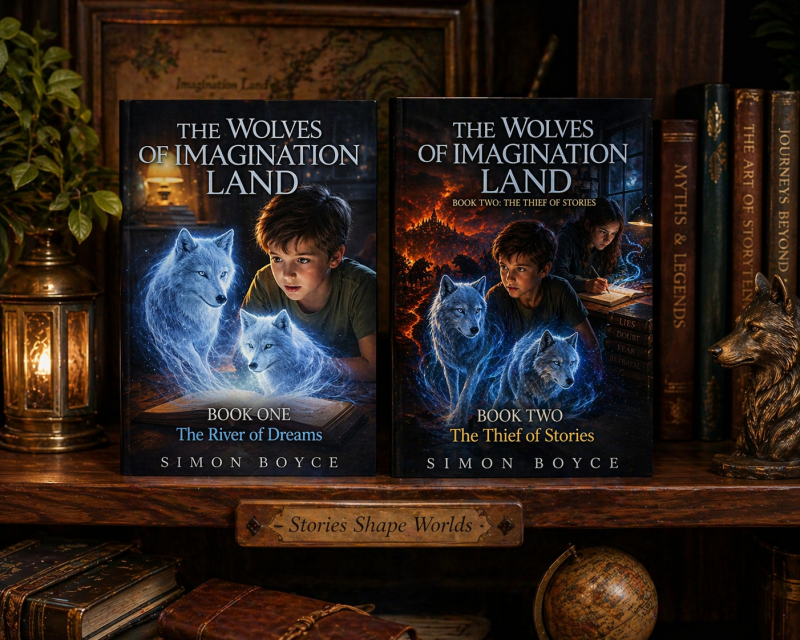
Book 2 The Thief of Stories.
What happens if someone else decides Luna and Juniors story.

The Wolves of Imagination Land
Book Two: The Thief of Stories
Chapter 1 – The Road That Wasn't There Before
By the time the second spring came to Imagination Land, the road between Terraced Street and Moonhill had become something people talked about in lowered voices, as though saying too much might make it vanish.
Some said it had always been there and they had simply never noticed it before. Some said it had been built overnight by unseen paws. Others—usually the old, the bookish, or the owls—said the road had not been made by paws at all, but by a change in the story itself.
That was the thing about Imagination Land.
A road could appear because two young wolves had become friends.
A river might shine brighter because someone in another world had dreamed of moonlight.
A tower might lean because a storyteller had decided crooked things were more interesting than straight ones.
And if enough people believed a thing belonged, sometimes the world agreed.
The road belonged.
How Books Can Challenge Stereotypes and Encourage Critical Thinking
Books have always been more than a source of entertainment. At their best, they shape how readers see the world, question assumptions, and develop independent thought. One of the most powerful ways they achieve this is by challenging stereotypes and encouraging critical thinking.
Stereotypes simplify people, groups, and ideas into fixed patterns. While they may seem harmless at first, they limit understanding and reinforce narrow perspectives. Literature has the unique ability to break these patterns by presenting characters and situations that defy expectations. When readers encounter stories that contradict what they have always believed, it creates a moment of reflection. That moment is where critical thinking begins.
Stories introduce readers to perspectives they may never experience in real life. A well written character with depth and individuality can dismantle preconceived notions more effectively than direct instruction. Instead of telling readers what to think, books invite them to observe, question, and draw their own conclusions. This process strengthens analytical skills and encourages a more thoughtful approach to information.
A strong example of this can be seen in The Wolves of Imagination Land by Simon Boyce. The story takes a familiar idea and turns it on its head. Wolves, often portrayed in a negative light, are given complexity, emotion, and individuality. Through characters like Junior and Luna, readers begin to question why certain roles exist in stories and whether those roles are fair or accurate. This shift in perspective is subtle, yet highly effective.
By presenting contrasting viewpoints, books also teach readers to evaluate information rather than accept it blindly. When characters come from different backgrounds and hold different beliefs, readers are exposed to multiple sides of a situation. This encourages them to weigh evidence, consider context, and recognize that truth is often more nuanced than it first appears.
Another key element is the role of curiosity. Stories that ask questions rather than provide easy answers push readers to think more deeply. Why do certain stereotypes exist? Who benefits from them? What happens when they are challenged? These questions do not always have simple answers, but the act of asking them builds intellectual confidence and independence.
Books also create a safe space for exploration. Readers can engage with difficult ideas without real world consequences, allowing them to test their thinking and refine their understanding. This makes literature an ideal tool for developing empathy alongside critical thinking. When readers connect emotionally with characters who are misunderstood or misrepresented, they begin to see beyond surface level judgments.
For younger audiences, this process is especially important. Early exposure to diverse and thoughtful storytelling helps shape open minded thinking. It teaches readers that not everything they hear or read should be accepted without question. Instead, they learn to look deeper, challenge assumptions, and form their own views.
In a world filled with information, the ability to think critically is essential. Books remain one of the most effective ways to develop that ability. By challenging stereotypes and presenting richer, more complex narratives, stories do more than entertain. They educate, inspire, and empower readers to see the world with greater clarity and understanding.
The Wolves of Imagination Land by Simon Boyce serves as a compelling example of how storytelling can reshape perception and encourage readers to think beyond what they have been told. to add text.
Reader reviews
Hear directly from our readers. See what others are saying about their experiences with our books and why they love the worlds we create.
Blog and updates
Stay current with the latest news, behind-the-scenes insights, and updates from The Wolves of Imagination Land. Don't miss a beat from our creative journey.
Has Luna and Junior have allowed me to tell their first story.
I now have the pleasure to continue with their next chapter.
"The stories from The Wolves of Imagination Land have transported me to incredible worlds. Each book is a masterpiece, filled with wonder and adventure."
A devoted reader